
From the Collection
It is difficult to pinpoint exactly when what is currently call ‘Contemporary Embroidery’ began.
The Avant-Garde movement emerged in the late 19th and early 20th centuries, during a time of rapid social, political, and technological change. Artists were inspired to explore new forms of expression and reject the constraints of traditional artistic conventions. Avant-Garde art is characterized by its experimental nature, unconventional techniques, and radical subject matter. Artists often use non-traditional materials and methods to create their work, pushing the boundaries of what is considered art.
This new approach to art, and the emergence of new materials in the mid 20th century encouraged embroiderers to experiment. Groups like the 62 Group (formed in 1962), started to bring young and creative designers together, and to explore the place of Embroidery as Art – a controversial subject, as the review of the 62 Group’s first London exhibition, published in Embroidery Magazine in the winter of 1968, clearly demonstrates.
‘Many people feel that as soon as the more traditional barriers of embroidery are broken down, it then enter the ‘fine art’ province, and as soon as this happens embroidery is no longer embroidery and perhaps a new name should be found.’
Embroidery today and tomorrow: Review of the 62 Group exhibition
Embroidery Magazine, Winter 1968
From these tentative steps , the concept of Embroidery as Art and the explorations undertaken by emerging artists in that field, slowly developed into an accepted contemporary approach. The use of mixed media, unusual fabrics, and deliberate challenges to traditional techniques have expanded the understanding of embroidery as an art form: today, the Textile Artist is recognised as a valued member of our community, their work sitting alongside more traditional pieces – and their art is celebrated.
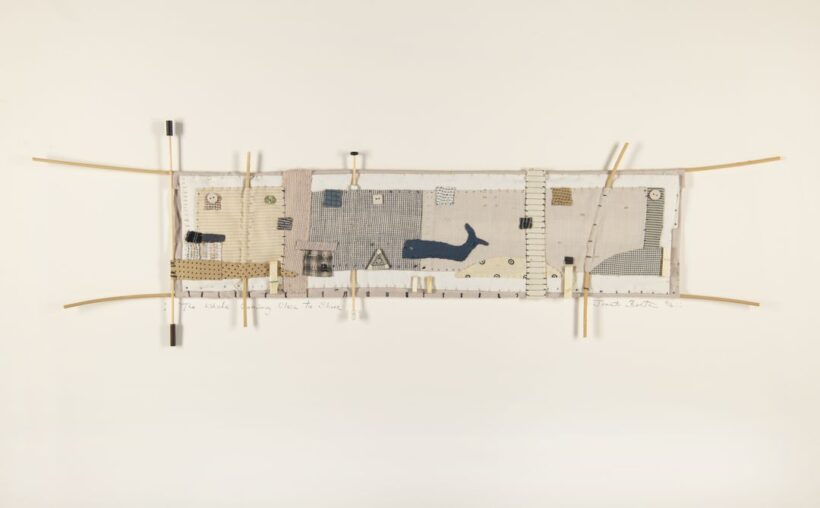
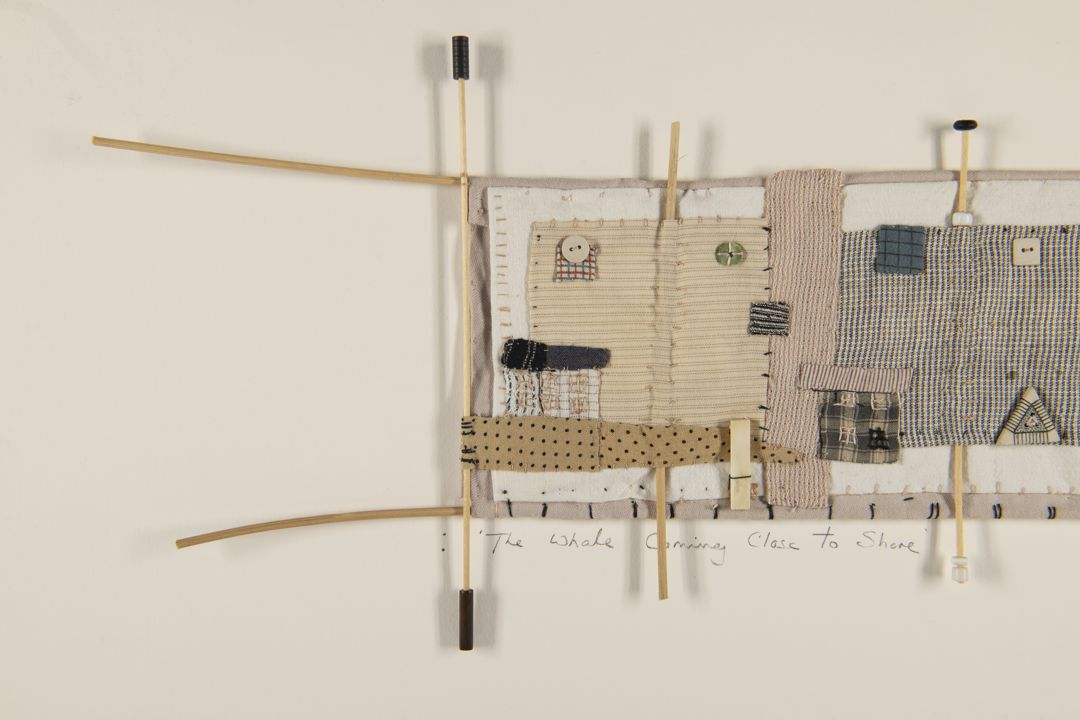
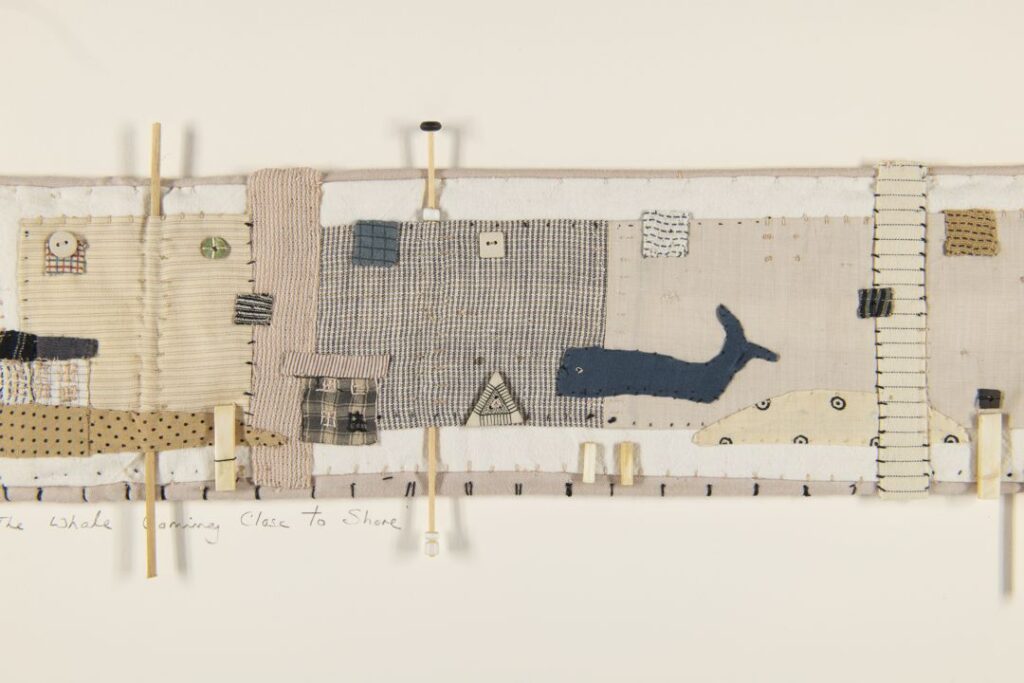
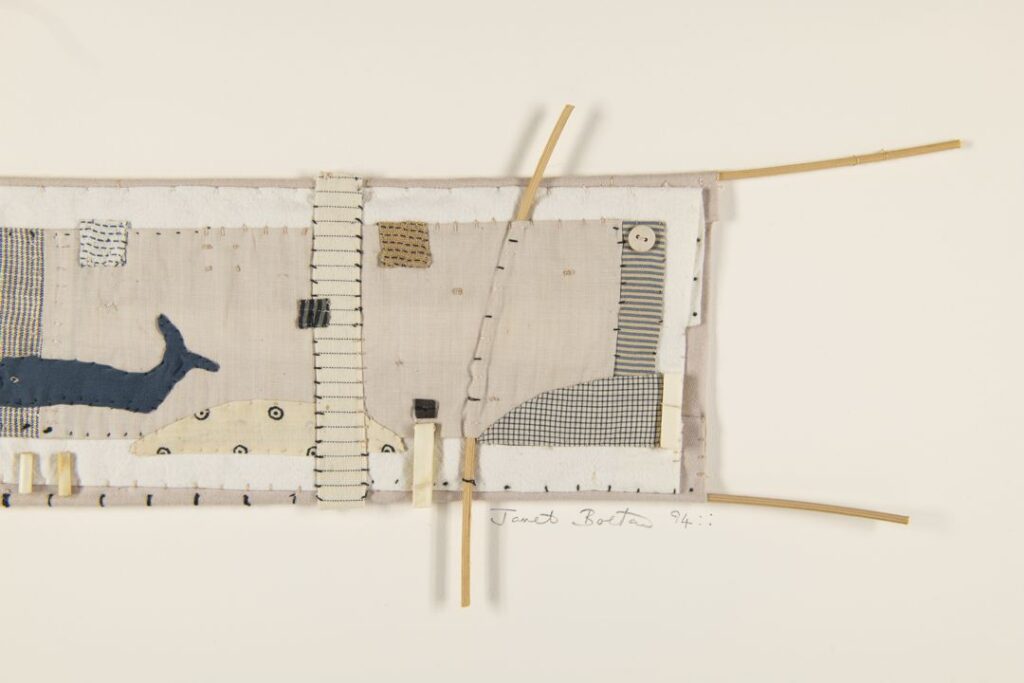
Item no EAMEG.1998.12 The whale coming close to shore (Full image above)
This piece from our collection was created in 1994 by Janet Bolton. Entitled ‘The whale coming close to shore’ it utilises a range of materials including plain and printed fabrics, 3D objects, and cane. It was hand stitched, and then framed and glazed with Perspex rather than glass. It is 65 cm wide and 21.5 cm deep. The stitching is simple, as is the design, and the colour palette is quite limited – but these choices help tell the story that the artist wished to convey, a quiet moment caught in time.
Contemporary work in the 21st century encompasses a wide spectrum, from simple hand stitches and freehand machining through to dense layers of stitching and even digital embroidery. It is both Art and craft, its creators using paint and dyes, threads, fibres, fabrics, paper, wires, metals, and a fascinating assortment of found objects and natural materials to tell their stories.
Find more items from our collection in our Art UK Gallery: Art UK | Discover Artworks
Collection photography by the Embroiderers’ Guild