Jan 2026 – Feb 2026
ON SALE NOW

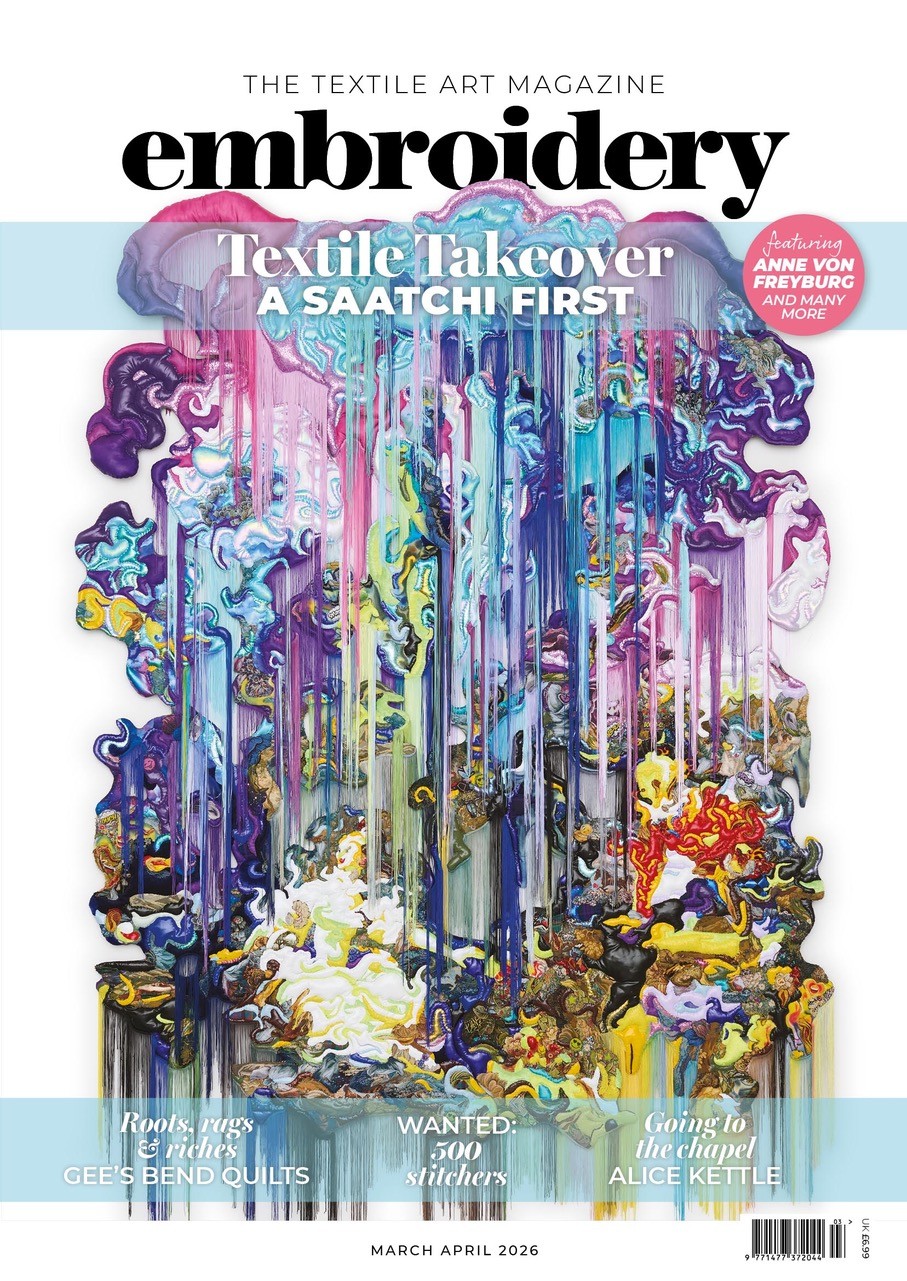
Embroidery magazine Jan/Feb 2026 issue is out now!
I LOVE TO SPOT wildlife. On all too infrequent mornings I slip out of the house at dawn and head towards one of two small woodlands a short walk away. Though we live in a large housing estate that is set to grow, these woodlands are protected and managed by Wiltshire Wildlife Trust, offering a rare haven for both recreation and flora and fauna. I usually pause at one particular woodland ride, waiting for a roe deer or muntjac and I’m often rewarded with the briefest of glimpses. But sometimes, the deer will stop and stare, perhaps as much in wonderment at this human interloper as I am on seeing them. I’ve also been lucky to spot a red kite flying directly above me under the tree canopy, tracking me as I walked. I’ve often wondered how to stitch these encounters in the early morning silence of the woodland, the stillness playing as much a character as the trees and animals.
A lover of bird life and key member of the Embroiderers’ Guild and magazine’s social media team, Suzy Ager’s embroideries speak to me for different reasons. The lapwing on our cover is a Red List bird, meaning it’s named in the latest Birds of Conservation Concern, published by the UK’s bird conservation and monitoring organisations. Suzy’s works are underpinned by her sketchbooks and what appeals about Lapwing is the way she has stayed true to her original drawings, ‘sketching’ with needle and thread on silk to create this ethereal rendition, rich with movement.
Lapwings live on pasture and wet grassland and are known as peewits because of their call. The name ‘lapwing’ sums up how they fly, zig-zagging through the skies. ‘Sadly, numbers of Lapwings have declined by 55% since the 1960s. Part of this decline is due to changes in agriculture,’ says the RSPB.
It’s a long-jump from the wintry great outdoors to the baking heat of summer 2025 when I first spotted the works of US artist Tamara Kostianovsky, her raw fabric animal carcasses dangling above visitors to the Royal Academy’s Summer Exhibition. Recent pieces include tree and branch-like structures resembling the inside of the human body, with colourful striations representing sinew, muscle and fat. These ‘wounded’ trees comment on how humankind is degrading nature but also relate to the loss of the artist’s father, her grief made palpable in these visceral works.
Equally arresting is the branch-like structural art of Barbara Long, whose sunny Milan studio we visit in the Sewing Room. Her art springs from a place of chaos and mess, with the artist admitting to often overspilling her studio. Barbara, who is also an art therapist, feels a strong and restorative link to the environment too, which she notes is a repository of humankind’s ‘mess’. With a feminist slant, she recycles domestic materials to make works that she wants people to interact with and touch.
We hope this issue touches you, illuminating winter’s darkness. The March/April issue isn’t far away when we’ll be back with a spring in our step…
Claire Waring
EDITOR
Embroidery magazine
NOTA BENE: The Dame Tracey Emin article on page 64 contains the forthright themes and language for which the artist is known.